
Automated tower · lift and transfer
Tower Parking System
Store cars vertically using an automated lift. Drivers leave and collect their cars at an entry bay while the system handles storage.
- Capacity
- Designed per site
- Retrieval
- Automated return to entry bay
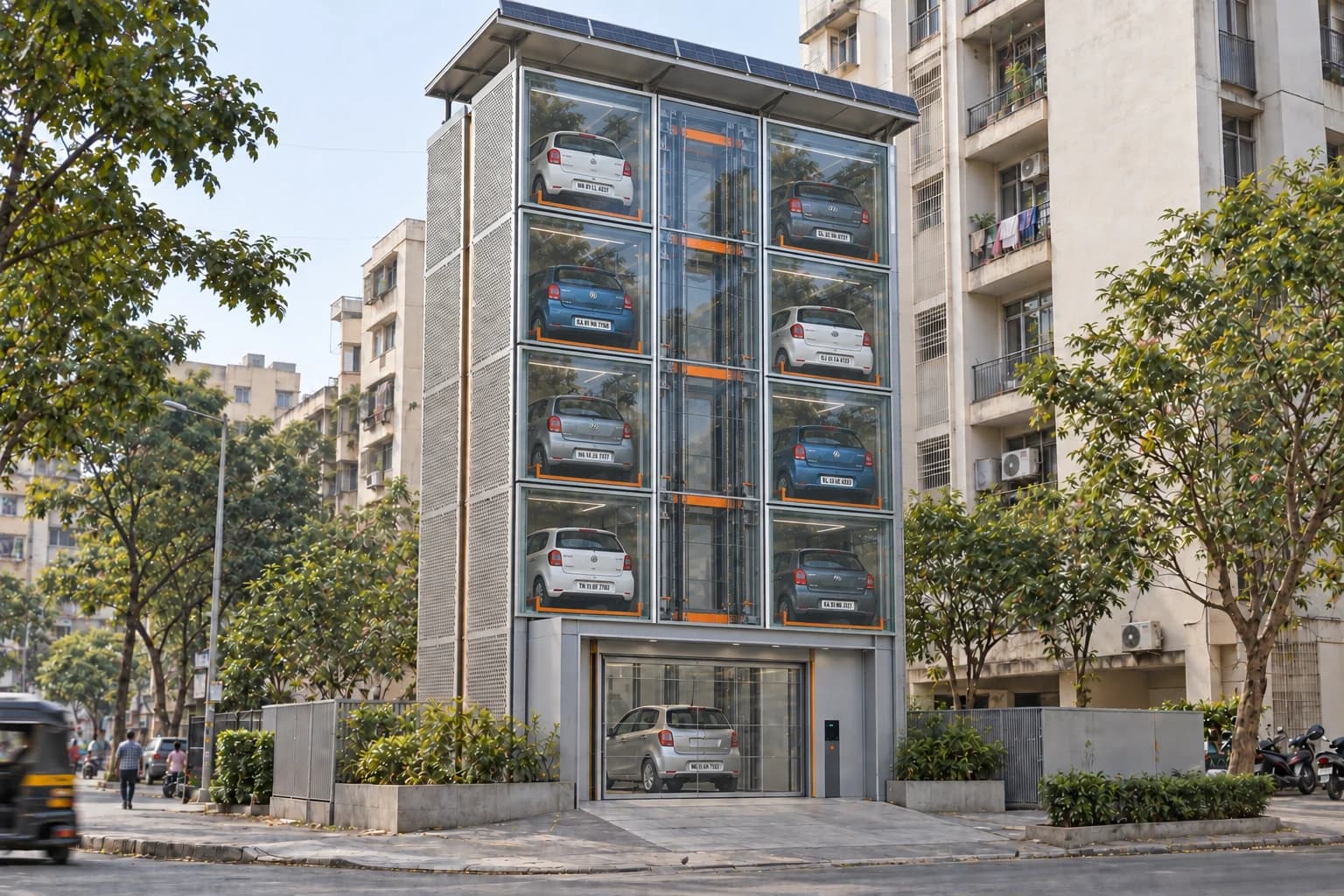
Site suitability
Where this system fits.
Urban plots with limited ground area where planning and structural conditions allow parking to extend vertically.
What to plan for
Check permitted height, vehicle dimensions and lift demand. Entry-bay space and queuing matter as much as the number of storage positions.
Typical settings: High-density residential · Commercial basements and urban plots · City-centre sites
Daily use
Parking and retrieval.
01
Leave the car at the entry bay
The driver parks in the entry bay and exits before the storage sequence begins.
02
Lift and store
An automated lift and transfer arrangement move the vehicle to its assigned storage position.
03
Return for collection
The system brings the selected car back to the entry bay. Return orientation is specified in the project design.
Specifications
The details that shape the layout.
The catalogue describes an automated vertical tower. Capacity, dimensions, vehicle load and cycle time require a project-specific specification.
Request a project specification- Type
- Automated vertical tower
- Capacity
- Configured per site
- Drive
- Electromechanical lift
- Control
- PLC with safety interlocks
Common questions
Questions before you choose.
- How many cars can a tower accommodate?
- Capacity is designed for the site. It depends on available height, storage layout, vehicle dimensions and the space needed for the lift and entry bay.
- Does the car return facing the exit?
- Return orientation depends on the transfer arrangement and whether a turning mechanism is included. It must be confirmed in the proposed design.
- How do I assess a tower for a busy property?
- Specify the expected arrivals and departures during the busiest period. Ask for a layout-specific assessment of retrieval time, queuing, power-failure operation and service access before selecting the system.
Check the fit for your project.
Share a site plan, required spaces and vehicle sizes. We can review the layout and define the next steps.